Originally published in The Yale Environmentalist magazine.
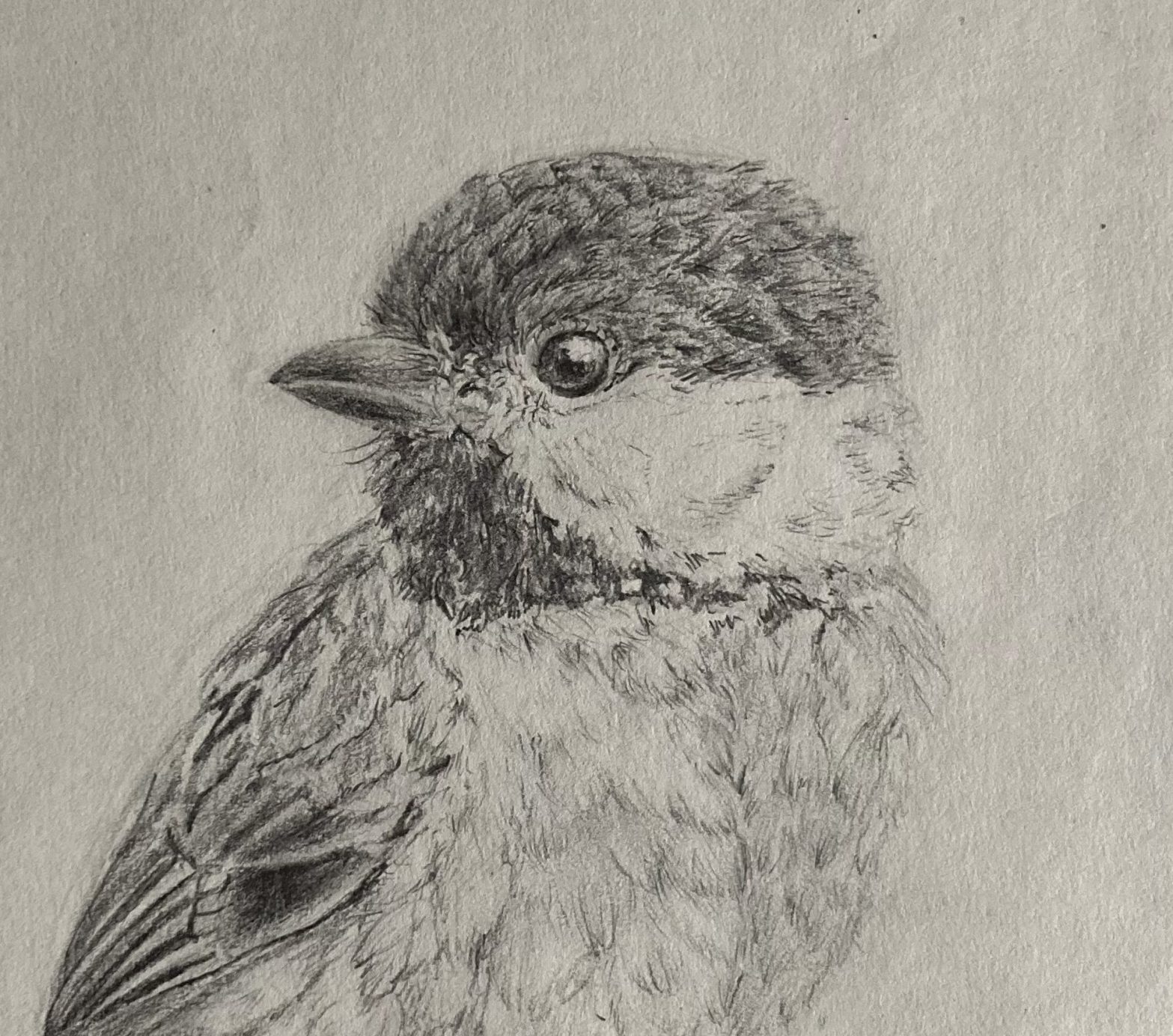
One of my favorite words comes from a bird language: the language of Black-capped Chickadees. It is typically written as chick-dee-dee-dee and is the source of their common name. It is classified as an alarm call and certainly carries meaning, yet is it fair to describe it as a word?
Like human words, chick-dee-dee-dee is an independent unit: it is the distillation of a specific thought. Chick-dee-dee-dee stands crisp and isolated on a page, made of familiar letters, looking no different from any English word. Of course, the chickadees’ word does not really sound like chick-dee-dee-dee at all––it is nasal and harsh and fast, made of sounds we don’t have letters for, formed by an organ called the syrinx that we don’t even have. But giving it a mnemonic we can read and pronounce demonstrates its wordhood in a way no vague auditory description ever could.
Like many complex human words, chick-dee-dee-dee is composed of multiple small subparts. Nothing can show that feature of the call better than pictorial spectrograms’ displays of the length, pitch, and intensity of sound. Unlike the written mnemonic, the spectrogram accurately represents how the call sounds: the curve at the beginning symbolizes the “chick” subsection of the call, while the stacked lines at the end illustrate the “dee-dee-dee.” Isn’t there a kind of onomatopoeic beauty to the graphs that English letters lack? They are an elemental alphabet perfect for describing the words of animals.

Most importantly, chick-dee-dee-dee is rich in meaning––perhaps even more so than most human words. Ornithologists studying the alarm call recently discovered that it varies with context. The number of dees at the end ranges from one to many, and the greater the number of dees, the greater the alarm of the bird. Knowledge of chickadee predators allows us to draw specific inferences about what they are saying.
Seven, eight, or more dees, for example, can suggest the presence of a Sharp-shinned Hawk, one of the chickadees’ most deadly predators. Three or four can alert us to raccoons or coyotes. Nothing feels more electrifying than hearing one or two dees explode above your head. You know the chickadees are talking about you.
Still, even this scientific understanding of the call’s meaning feels incomplete. Words are only fully understood in the context of their society. We might translate a word into our own language, but without an intimate understanding of its home culture, we cannot grasp its subtleties. Learning any language should extend beyond the memorization of vocabulary and grammatical structure to cultural and societal details associated with the language. Yet who among us can claim intimate knowledge of Black-capped Chickadee society?
The chick-dee-dee-dee call means danger, but when heard, all the local chickadees and other small songbirds fly toward the sound, knowing that together they stand a better chance of harassing the threat into leaving instead of hunting. How can we understand that selflessness implied by chick-dee-dee-dee? The word expresses a cooperativity extending beyond chickadees to all species who join to combat common enemies.
Chick-dee-dee-dee, then, is a word that transcends species. We hear it as birdsong, creating background noise in a forest full of creatures that hear and understand it as so much more. Upon reflection, that human inability to grasp its meaning is the anomaly. This understanding fits chick-dee-dee-dee into a language, one more immediate and visceral and communal than any human language, yet one just as worthy of consideration. What is a language if not a system of words used to communicate, and what is chick-dee-dee-dee if not a part of a rich and varied forest language whose edges we can only grasp at?
Around us in a forest, life passes and is spoken about. Bobcats and foxes speak a silent, predatory language to themselves as they hunt; squirrels chatter with each other about the acorns, the weather, the bobcats. The deer speak a sign language of alarm involving wide eyes and pricked ears and the flash of white tails. Flowers sing in color about their bounty for the bees; surely even the trees themselves, through their underground mycelial webs, can be said to commune. And chickadees, the most voluble of songbirds, talk to keep each other safe.

 Molly Hill