Originally published in The Yale Environmentalist
Many of the features that have made Los Angeles so appealing to the movie industry – a gentle climate, habitats ranging from beaches to mountains, scenic and pervasive palm trees – also make it an ideal city for birds. In addition to supporting one of the most diverse native bird communities of any city in the country,[1] Los Angeles County is also notable for being home to a wide range of introduced species from around the world. These birds take advantage of the habitat variety, abundance of food, and surplus of native and introduced plant species to survive. Many, including peacocks, munias, and bulbuls, have established thriving naturalized populations throughout the city.
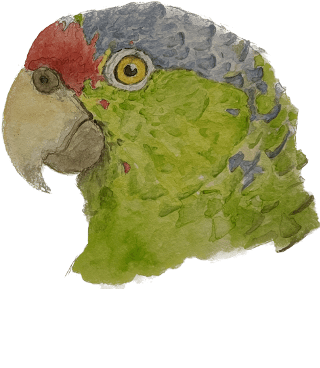
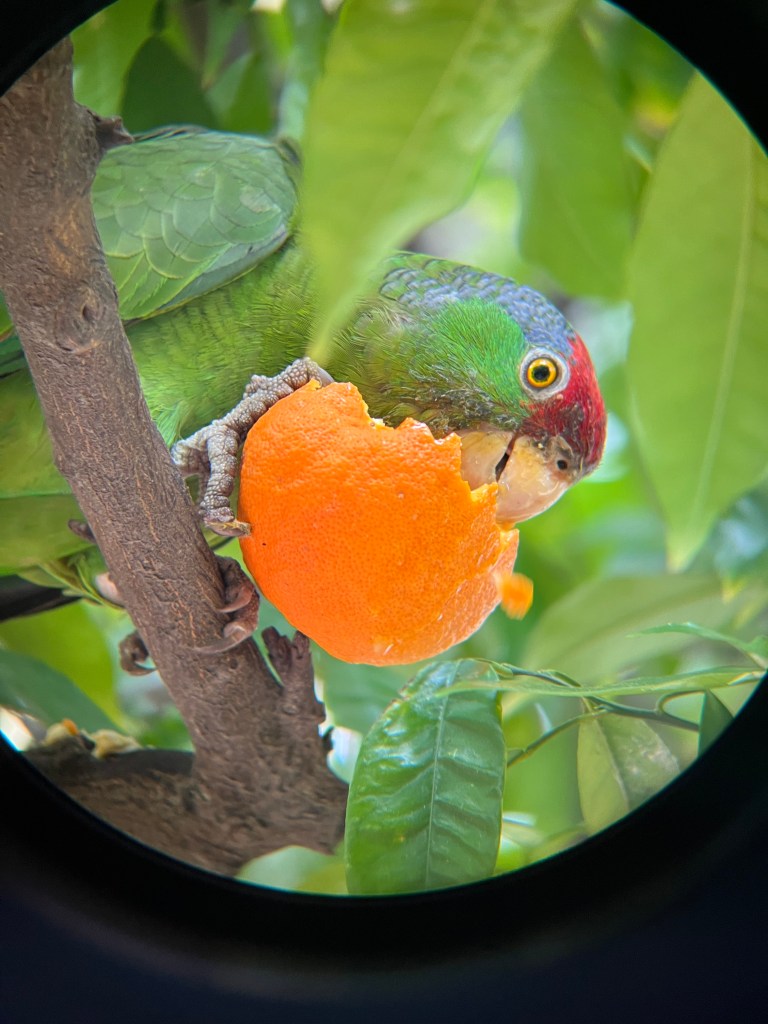
Among my favorites of the introduced species are the parrots. Around a dozen species are currently found in Los Angeles, and one of the most common is the Red-crowned Parrot. Native to a small area in northeastern Mexico, they’ve likely lived in Los Angeles for at least a half century. They’re big, neon green birds with bright red patches on their faces and wings, and they live in large, social flocks throughout the city.
I can’t remember the first time I saw a Red-crowned Parrot. They formed an essential, amusing, often exacerbating part of the landscape I grew up in. I’d regularly hear small flocks near my house, and on numerous occasions my whole family would wake up to the ear-splitting sound of a group eating their breakfast in our pecan tree. On those days, when I was torn between running outside to watch and wanting to vacate the premises to protect my ears, I certainly learned why groups of parrots are called pandemoniums.
Loud and pervasive as the parrots are, my family was far from the only one to notice them. Like the peacocks – the only other introduced species to rival the parrots in beauty or volume – parrots tend to divide human residents. Many people find them charming and fascinating; others are put off by the noise. Still, most of the neighbors I knew growing up seemed to have at least a grudging affection for them. If nothing else, they bring neighbors together to debate increasingly elaborate origin stories for the LA parrots (my favorite is that the producers of the Tarzan movies purposefully set a bunch of parrots loose in the city so they’d be realistically flying through the background of jungle scenes). Taken together, Red-crowned Parrots seem to be among the least fraught or dangerous introduced species. They don’t kill or outcompete native animals, they don’t appear to overconsume native plants, and they barely encroach into native ecosystems since they are restricted mostly to suburban and developed areas of the city.[2] Their greatest fault is being too loud. But, as is the case with most introduced species, the story is complicated by factors outside the parrots’ control. In their native range, Red-crowned Parrots are becoming severely endangered by habitat loss and poaching for the pet trade. There may be more Red-crowned Parrots in Los Angeles than in all of Mexico.[3]
To try to bolster the wild populations, some biologists have suggested catching Los Angeles birds and releasing them in Mexico. But Red-crowneds are not the only parrots in LA. In the city, they live alongside other introduced parrot species, including many of their close relatives such as Lilac-crowned and Yellow-headed Parrots. In the wild, these species are separated by hundreds or even thousands of miles, allowing them to have diverged into new species over time. But when brought together in California, they form mixed-species flocks, and they can and do interbreed.
First generation hybrid parrots look distinctive, combining features of both their parent species. I volunteered for a study that looked for evidence of hybrid parrots throughout Los Angeles, and almost as soon as I started looking for them, I saw a Red-crowned x Lilac-crowned hybrid less than a block away from my house. Even more strikingly, genetic samples taken in the same study may indicate that many parrots in Los Angeles have some hybrid ancestry, regardless of whether that ancestry is visually obvious.[4] In the artificial sympatric population created in Los Angeles, the boundaries between the different species seem to be less firm. Instead of maintaining many separate introduced populations, these closely-related parrots may be forming a new, larger population with significant gene flow between all of the “species” present. It’s a situation that challenges the very definition of species, which traditionally requires the absence of interbreeding.

How can we release Los Angeles Red-crowned Parrots back into Mexico knowing that they are also the descendants of other species? If the native birds become endangered enough, we may have no better options to save them. Yet it is possible that the species have evolved in different ways that make the hybrid birds less fit for their original environments, and reintroducing them to Mexico may not help the native population as predicted.
Regardless, the Red-crowned Parrots in Los Angeles demand our further consideration. Many of them likely came to the city as products of the very pet trade that is driving the native population towards extinction. How can I, and other residents of Los Angeles, be responsible stewards of a population that is the product of such a destructive enterprise – especially when that population is now healthier than the original? It’s dangerous to think of Los Angeles’ parrots as insurance against extinction in native populations, but it may also be irresponsible not to consider using them as such. And on a daily basis, whether we’re covering our ears against their screams or laughing as they try to hang upside down from tree branches too thin to hold their weight, how should we think of them? How should we feel about them?
This is not just a question for humans in Los Angeles: introduced species present complicated moral dilemmas wherever they’re found, and they’re found virtually everywhere. They are the House Sparrows and Rock Pigeons whose range maps are almost duplicates of ours. They are the bees and earthworms we take with us for agriculture; the cherries we grow in Michigan and tomatoes in Italy and potatoes in Ireland; eucalyptus trees side-by-side with oaks along California highways; phragmites competing with cattails in eastern marshes. Rats, and the cats who follow them, are carried everywhere we’ve ever sailed.
I know many biologists, especially conservation biologists, are almost categorically opposed to introduced species. They often cause incredible damage and have been responsible for countless extinctions. Even when their effects are less extreme, it is hubristic to think we can move so many species around the world without consequence. In this age of globalization, humans are homogenizing the globe. By mixing species around, we are connecting ecosystems never before connected in Earth’s history. In doing so, we simplify them: Earth was a collection of uncountable, unique habitats, each with its own evolutionary history, its own set of species helping it function. By connecting and mixing species across habitats, we turn Earth into a much smaller collection of a few habitat types. All marshes begin to grow the same reeds; all forests begin to look alike. The same bees pollinate the same flowers in California and Connecticut and Kolkata. The same parrots live in California and Veracruz and Florida.
Yet I don’t say this as someone staunchly opposed to introduced species. I cannot imagine my home without them. Without Indian Peafowl displaying their five-foot tails on the sidewalk in front of my house, without Red-whiskered Bulbuls nesting outside my window, without pigeons sailing above every skyscraper, without Fox Squirrels stealing kids’ lunches at my elementary school, without honeybees nesting and making honey and stinging me in my backyard, without parrots wheeling overhead, Los Angeles would be a vastly different – and less vibrant – place. As it is, I can see wild, free-living birds from every continent except Antarctica within driving distance of my house. There’s something incredible about that: it connects me, through the shared understanding of an animal, to places I’ve never been and people I’ve never met.
And on a deeper level, I cannot hate non-native animals. Parrots did not choose to be hatched in Los Angeles instead of Veracruz. The peacocks did not ask their ancestors to be imported by cattle ranchers in the 1800s. House Sparrows that outcompete native birds are only trying to survive. Even cats, who – I know – kill billions of birds each year in the United States alone, are only doing what cats evolved to do.
I don’t know how to deal with nonnative species. I don’t believe there is one solution. I want to preserve the uniqueness and diversity and histories built into every habitat on Earth, while also saving some consideration for the real individuals, full of their own feelings and intentions, who through no fault of their own find themselves in the wrong places. Perhaps in certain situations, such as isolated, vulnerable islands, it may be necessary to kill introduced species in order to save entire ecosystems of native ones. But I think in other places, they should be tolerated and respected. Humans are changing the way the world works in far more ways, and far more drastically, than we can comprehend. Not all those changes are inherently bad; cities like Los Angeles are already constructed ecosystems utterly unlike the habitats once found there. Maybe we can find a way to celebrate the fact that there’s room in this new ecosystem for birds – some of the smartest and loudest and strangest birds on the planet – to form their own, entirely new flocks, to fly together over desert hillsides on their jungle-green wings.

[1] Top Counties. (2023, May 5). eBird. Retrieved 5 May 2023 from https://ebird.org/region/US-CA/regions
[2] Wenda, L. (2020, December). The Naturalized Parrots of San Diego County. Sketches: San Diego Audubon, 72(2), 2–4. https://www.sandiegoaudubon.org/file_download/inline/7c2f1d86-38ac-4963-9c26-e74b53577b8f
[3] Conroy, G. (2019, June 5). Exotic Parrot Colonies Are Flourishing Across the Country. Audubon. https://www.audubon.org/news/exotic-parrot-colonies-are-flourishing-across-country
[4] McCormack, J. (2021, May 8). New Study on Red-crowned and Lilac-crowned Parrots. iNaturalist. https://www.inaturalist.org/projects/free-flying-los-angeles-parrot-project/journal/51384-new-study-on-red-crowned-and-lilac-crowned-parrots
 Molly Hill