
I lived for a month this summer on a small island in the Bay of Fundy. Kent Island was just a mile and a half long, home to little more than grass, a small biological research station, and me and the other twenty or so researchers living there for the summer. Clinging to existence at the edge of the Atlantic, Kent is so remote it has no native mammals, ticks, or snakes. On Sundays, our weekly day off, we could stroll barefoot through the fields, fearless.
Usually, I strolled to the Shire. The island was mostly windblown grass, but in the north a small patch of forest grew. The forest’s name was apt – it really did feel taken from Middle-earth. The spruce and birch trees were all draped in Usnia lichen, which waved in the breeze like tatters of fog. The soil was crumbling and dark and mostly covered by waist-high ferns and mossy logs. Tiny paths wound through it all, their size better suited to hobbits than humans. Every few feet along the paths, a small hole was dug in the ground. Most were covered by a lattice of fern stems laid across the top like a mesh doorway. They looked like the entrance to a fairy’s lair.
They almost were: they were the entrances to Leach’s Storm-Petrel nests. Storm-petrels are tiny brown seabirds related to albatrosses; they spend most of their lives at sea and come to land only to raise a single chick each year. Leach’s Storm-Petrels breed on Canadian islands like Kent but spend each boreal winter off the coast of South Africa. After fledging, the young fly off and don’t return for three years.
“Grubbing” petrels – the process of censusing the population by checking the occupancy of each burrow and banding any birds present – was an unparalleled sensory experience. I learned to lie flat on the muddy dirt, roll up a sleeve, and reach down a tunnel barely wider than my arm, hoping to find a storm-petrel instead of spiders or sharp rocks. I grubbed many burrows and only found a petrel once. Suddenly, out of the cold and wet, there was a bird: warm and downy and trying to bite me. I worked my hand past her snapping head, wrapped my fingers around her chest and wings, and haltingly pulled her the long way out.
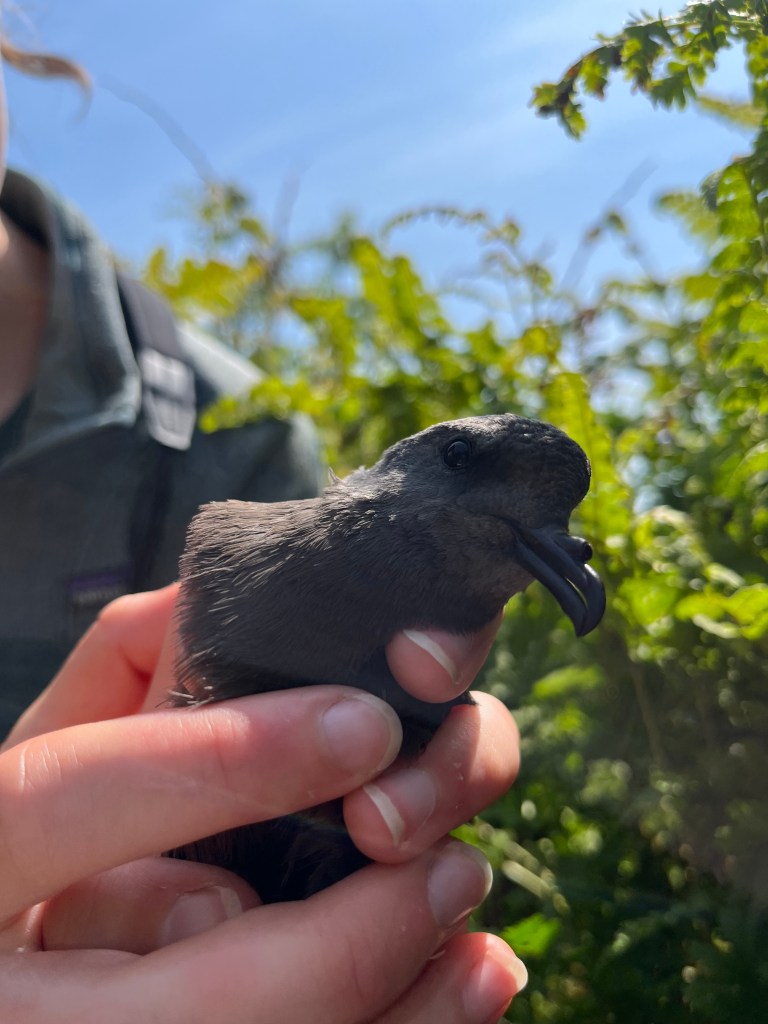
She looked small in the daylight. We looked up her band number – she was a female, sexed by DNA testing some previous year. Petrels live into their thirties; she may have been older than I was. Her webbed feet, the size of my thumbnail, kicked gently. Her bill was capped by twin tubes, elongated nostrils that filter out salt and let her drink seawater. Her body was not really brown but many subtle shades of grey, an ashy gradient from her face to her wings to her whitish tail. She was exquisitely soft. I held her close to my face, tempted to nuzzle her. She smelled like soil – damp bark, rotting humus, a warm wet body. She smelled like what she was: a waterbird who’d crawled into the earth. Her eyes were a liquid red-brown.
It was harder to find a free-flying petrel. Leach’s Storm-Petrels are incessantly mobile: while breeding, one bird guards the nest while their partner flies all the way to Cape Cod to feed; the pairs switch every few days but otherwise cannot interact with each other. They’re nocturnal and only return from foraging trips late at night, long after I was asleep. But one night shortly before I left the island, two of my friends and I stayed up and walked toward the Shire.
There was no moon. We had no flashlights, so the darkness was nearly entire. The stars were piercing. After a while we realized the pale diagonal smear across the sky was not a trick of our eyes but the Milky Way.
We heard them before we saw them. Their “purr and chatter” calls are unique among birds; explosive, rattling, and oddly musical, they sound like a DJ scrubbing a record somewhere in the forest. The ground and the air soon erupted with chattering as the foraging birds reunited with their mates. Finally, we saw one dart over the field. It was dark and had a fluttering, stumbling flight. It reminded me more of a bat or an overgrown moth than a bird. More birds followed the first, and for a long time we said nothing. The world was soft with darkness and cold, filled only by these fluttering shadows and their chirruping calls.
Finally, the cold forced us to head back to shelter. The trail home cut through the forest, but it was so dark I could only see the trees within ten feet of me. My friends, walking just in front, seemed not to be walking into blackness but into a fog of nothing, a pixelated grey haze my eyes invented. I could still hear the petrels calling to each other as we walked. At each step, the forest created itself out of the dark.
 Molly Hill