Part of my undergraduate senior thesis in Humanities; awarded the John Hershey Prize in Journalism for graduating seniors by the Yale English Department.
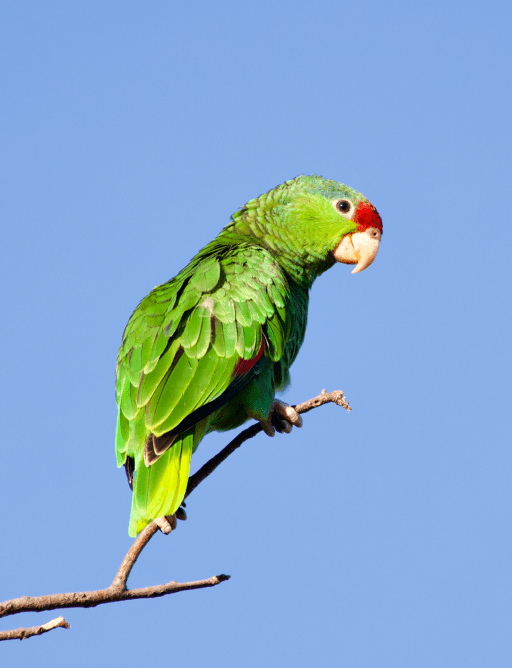
Most people utilizing the parking lot at the corner of Rosemead and Broadway are there for the Korean BBQ restaurant. Aside from the restaurant, there is a massive grocery store, a tiny dentists’ office, hair and nail salons, and a dance studio. Yet the many human visitors to the parking lot are greatly outnumbered by birds. Hundreds if not thousands of parrots – mostly Red-crowned Amazons, but also Lilac-crowned and Yellow-headed Amazons, and a variety of parakeets – gather here each evening in the eucalyptus trees behind the restaurant to socialize and roost together. The descendants of escapees from the pet trade, most are native to Mexico and Central America, and all seem to thrive in the highly humanized landscape of Temple City, a suburb northeast of Los Angeles that is overlooked by the San Gabriel Mountains.
They begin arriving up to two hours before sunset. The early birds wing in from the north and circle above the roost, squawking. Amazons are distinctive in flight; the large, bright-green parrots often fly in ragged, diagonal lines like undisciplined geese, with rapid, shallow, mechanical wingbeats. Eventually, they alight in row of small trees in the center of the lot where they forage and disappear surprisingly well into the leaves. As they socialize and feed, they chuck the gnawed remains of nuts to the ground, hitting cars and, once, me. Though typically rather shy, here they gather in large enough numbers to be bold. They watch me as I watch them, turning first one and then the other wide orange eye to face me – in a challenge? Curiosity? I want it to be a greeting.
As the sun reaches the horizon, the parrots briefly become restless. In a nightly ritual, massive groups lift up from the trees in unison – hundreds of amazons in a rattling, shrieking, fluttering cloud that circles the parking lot a few times before drifting back down into the taller trees. The human visitors are accustomed to the parrots and mostly ignore them, but when these largest flocks take flight, many can’t help but pause by their cars to stare for a moment. Immense, fluid yet synchronized, and silhouetted by pink and orange clouds at sunset, these flocks are stunning. They are also ear-splittingly loud. As the sky grows darker, they continue socializing in the trees, but their energy flags and finally – thankfully – they quiet. When the sky darkens from dusk into night, they decide, in almost perfect unison, to stop shrieking and go to sleep. Everything is quiet until dawn.
Red-crowned Amazons are part of a community of dozens of non-native bird species from around the world that have been transplanted to the Los Angeles region. But among the colorful songbirds and peacocks from Asia, the streamer-tailed whydahs of Africa, and the ubiquitous pigeons, sparrows, and starlings of Europe, the parrots stand out. They are probably the loudest birds here, native or otherwise, especially when they gather at their roosts. But even when they quiet down, there is something jolting – something so obviously out of place – about seeing a flock of parrots wheeling between palm trees, silhouetted against the desert sun and the San Gabriel Mountains. Yet they seem perfectly happy to find themselves in suburban parking lots, unaware that they should be in montane forests hundreds of miles distant.
Parrots are also extremely intelligent, probably the smartest of Los Angeles’ avian newcomers. Their intelligence means their vocalizations are more than mere screams; parrots have some of the most complex communication systems of all birds. As they swing from telephone wires and toss chewed-up nuts on my head, I can’t help but wonder: what are they saying to each other? What are they saying about us?
§
Parrots have been in Southern California since at least the 1950s. Stories proliferate about how they arrived; I was told growing up that they were imported to serve as set pieces for the Tarzan movies filmed at the Los Angeles County Arboretum and left behind when the shooting finished. Others point to escaped pets or menagerie birds, or a pet shop owner, in Van Nuys or Pasadena or somewhere, releasing its birds to save their lives when the store burned down.[1]
In reality, parrots have likely escaped or been released to Los Angeles many times and for many reasons over many years. Today, a total of thirteen parrot species are considered naturalized, having established self-sustaining wild populations in Southern California. A large and diverse group – including many Red-crowned Amazons, but also Lilac-crowned and other amazons, along with Mitred, Red-masked, and Yellow-chevroned Parakeets – lives in the San Gabriel Valley, an approximately 50-mile stretch of suburban sprawl flanked by its namesake mountains in the north. These parrots share the roost at the Temple City lot. Others live in the San Fernando Valley and west LA in smaller numbers; some Lilac-crowned Amazons and Nanday Parakeets inhabit the coastal canyons of Malibu; another diverse Amazon population lives in Orange County; and most of these species can be found again in San Diego. Wherever they live in large numbers, they gather in roosts to sleep and socialize each evening before fanning out over many miles to forage during the days. At their communal roosts, many species often come into contact with each other. They eat, rest, interact – and sometimes interbreed.
Red-crowned and Lilac-crowned Amazons are two such interbreeding species. Each other’s closest relatives, both are large, bright-green parrots with red patches on their foreheads and only differ slightly: Red-crowneds have larger, brighter red patches with paler eyes and facial skin; Lilacs have small, maroon forehead patches, dark orange eyes, and darker grey skin. In Mexico, the two species are found on opposite coasts and never encounter each other, but in California, they can – and do – interact and interbreed. Professor John McCormack and master’s student Brenda Ramirez at Occidental College’s Moore Lab of Zoology are currently studying their hybridization. Ramirez and McCormack say their preliminary results suggest that so far, the birds still mostly mate within their own species, though there are hotspots where hybridization is more frequent.
In Mexico, Red-crowned and Lilac-crowned Amazons depend on undisturbed scrublands and forests, but in California, they are almost entirely restricted to urban and suburban environments. In another recent study, Ramirez and McCormack demonstrated that both species’ niches – the resources a species requires and the role it plays in an ecosystem – have shifted significantly since their introduction.[i] Both species are now found at lower elevations, with less green vegetation and lower average temperatures than in their native ranges, and although in Mexico their niches differ markedly – Lilac-crowneds live in more seasonably variable habitats than Red-crowneds – those differences have largely disappeared in California. These convergent niche shifts mean the birds are living in the same spaces and utilizing the same resources, which in turn means they encounter each other and have more opportunities to hybridize.
Such rapid, dramatic niche shifts are not unique to the parrots of Los Angeles. Urban populations of Red-crowned Amazons are now found in Texas, Florida, and Hawaii; Lilac-crowned Amazons live alongside them everywhere but Hawaii. Simon Kiacz studied how these birds survive in Texas for his doctoral research at Texas A&M University. Though Red-crowned Amazons are actually considered native in Texas, thought to have flown over from northeastern Mexico, the Texas population is similar to other US populations in that the birds gravitate toward urban spaces harboring many introduced amazons.
Kiacz explained that “intelligence, sociality and knowledge sharing, and their long lives certainly play important roles in their ability to successfully inhabit novel and urban environments.” Their ability to learn from each other allows them to work together to collectively figure out how to survive: where to roost, where and what to eat throughout the year, how to avoid urban predators, and so forth. This information was passed down, generation to generation, until the nature of the urban birds fundamentally changed. Now, according to Kiacz, “they want what we want – year-round flowering and fruiting trees, irrigated lawns and food sources and nice big trees to roost in.” In fact, Kiacz suspects that amazons “likely wouldn’t persist outside of urban regions in the US – not necessarily because they aren’t capable of it, but because they pass on generational knowledge of survival in urban areas.”
Culture is the technical term used by many biologists to describe the generational knowledge and behaviors passed down through social learning. Though the line between socially learned and genetically innate traits is often hazy, parrots are clearly cultural creatures: not only do they learn what and where to eat and retain cultural roost sites for decades, but the very vocalizations they use to pass along such information are themselves learned. Even among social learners, vocal learning is rare in animals, restricted mostly to parrots, songbirds, and some mammals like apes and whales. Among parrots, amazons seem to have particularly large and complicated communication systems: they make a wide variety of calls, and these vary according to regional dialects.[ii] The fact that their communication is culturally inherited means Los Angeles is more than a biological hybrid zone: it is a site of cultural contact between avian societies.
Cultural contact in humans can dramatically change languages – English, for instance, is a confluence of Germanic roots with Romance influences – and can even result in the creation of new ones. Pidgins (pronounced like pigeons) are the incomplete, hybrid systems of communication created when speakers of different languages begin to communicate with each other; if contact persists, pidgins can eventually grow into creoles, which are full hybrid languages. Might amazons – who have already shown themselves to be human-like in that they are intelligent social learners with a penchant for ornamental fruit trees – culturally interact in human-like ways? Might Los Angeles parrots be speaking a parrot pidgin?
§
I live just a couple miles from the Temple City parrot roost and needed a project for an undergraduate thesis in biology, so I decided to investigate. Based on recordings from their native ranges, Red-crowned and Lilac-crowned Amazons have similar but distinct vocalizations, with Lilac-crowneds generally sounding higher-pitched and squeakier. My plan was to record both species at various roost sites around California and see what I found.
Despite living in Los Angeles my whole life, I had never paid much attention to what the parrots really sounded like, so I started by familiarizing myself with the Temple City birds’ vocalizations. Red-crowned Amazons make an impressive variety of calls while socializing, which can sound at turns like warbles, wails, whines, rattling, chuckling, and deranged laughter. These social calls flow and merge with each other fluidly; after dozens of hours spent listening, I still struggle to recognize discrete categories. I’ve focused my efforts on a few of the more distinct calls, particularly the “bark,” which is a common multipurpose call, and the “takeoff squawk,” which is essentially a series of harsher, louder barks used to announce a bird is taking flight.
The next roost I visited was thirty miles south, at a community park in Orange County. I saw Lilac-crowned Amazons for the first time here – they were quite common at this roost alongside Red-crowned Amazons, and I was surprised to see many hybrids as well. I listened intently to see if the Lilac-crowneds would be squeakier and higher-pitched, like they are in Mexico. While the height of the trees made differentiating the species difficult, the overall gathering of birds did sound a bit squeakier than in Temple City.
I found a good recording spot by some large ficus trees: the birds would often take off from these, loudly, circle around for a few minutes calling, and then land again. This pattern gave me a chance to record them calling in flight and then identify them to species once they landed, a task much easier with perched birds than those zooming by overhead.
On my second visit I realized, with a sudden jolt, that the birds taking off from the ficus trees sounded different. They still gave a takeoff squawk involving a series of loud, harsh bark notes. But before the barks, they added one or two clear, descending whistles. The difference was so obvious I couldn’t believe I hadn’t noticed it immediately; now, listening to the dozens of birds milling around the trees, it seemed the squeakier quality I had noticed was because they generally whistled more frequently than the birds in Temple City. And the whistles were not restricted to Lilac-crowneds: all the birds, including hybrids, pure Red-crowneds, and even a rare Red-lored Amazon added the same distinctive Orange County whistles to their takeoff squawks. Realizing this, I probably looked ridiculous, darting back and forth between the ficus trees after birds, brandishing my binoculars and microphone, grinning and muttering notes into the mic. But I didn’t care: I had driven thirty miles south, and the parrots had a southern accent.
Since that day, I’ve also recorded at two additional roosts. One is further south still in San Diego, where I encountered another mixed-species roost that uses the same whistled takeoff squawk. And back in LA County a small, almost exclusively Lilac-crowned population roosts in an apartment complex in Crenshaw, a south LA neighborhood only fifteen or so miles from Temple City. Overall, these birds sounded the squeakiest of all – probably because they comprised the most Lilac-crowneds – but they shared the same harsh takeoff squawk as the Temple City Red-crowneds, no whistle to speak of.
In comparison to recordings available online of takeoff squawks from Mexico, it seems that each species in California differs from its native counterpart. This implies that new dialects are emerging across Southern California. Species identity does matter to some degree: Lilac-crowned Amazons still sound more squeaky, on the whole, than Red-crowneds. But at least for some calls, like the takeoff squawk, birds of both species now exhibit a new, distinctly Californian way of talking.
Because parrots can live for decades, we can theorize that some of the very first escaped or released parrots are still out there. Imagine what those first parrots have seen in their decades of life. They may have hatched in the wild – perhaps they have dimming green memories of a nest amid a sea of trees and the sounds of their family. But they likely spent most of their lives in cages, possibly alone, until they escaped or were set loose or flung from their confinement before a fire. Suddenly free, they found each other – mostly Red-crowneds at first, but Lilac-crowneds too – and while exploring the fruit trees and parking lots and eucalyptus tree stands of their new home, they began to speak with each other. The first escapees might have retained memories of Mexico, but with each generation hatched in the wilds of Californian suburbia, the birds became less connected to their ancestral cultures and behaviors. They began to socialize across species, and as they did, they adjusted their calls to match one another for easier understanding. Some mated, and these pairs raised their hybrid chicks on parrot pidgins. As the years passed, the mingling birds multiplied, forming roosts across the metropolis that had little or no contact with each other. Through the normal processes of cultural change, regional dialects appeared. Today, their calls reflect not just whether they’re Red-crowned or Lilac-crowned Amazons, but whether they’re Los Angeles or Orange County Amazons.
Biologists generally look unfavorably on hybridization, at least when it is brought about “unnaturally” by humans: it is fundamentally a loss of biodiversity. Likewise, cultural hybridization results in the loss of cultural diversity as two societies smudge into one. To make matters worse, the latter can accelerate the former in a self-perpetuating cycle.
But viewed another way, we might see the parrots not as losing two cultures, but as creating a new one. The parrots in California have done something remarkable: they have flown from their cages out into a desert metropolis and together figured out how to survive. They have managed to create a novel, human-modified niche for themselves; as far as we can tell, they’re not directly competing with any native species. And though Red-crowned Amazons are endangered in Mexico, both species do still exist there. The ancestral cultures have not been lost. So rarely, in this age of climate change, invasion, extinction, devastation, do we have any good news from nature. California Parrots aren’t hurting anyone: they’re just becoming themselves. Why shouldn’t we step back and let them?
§
In November of 2023, someone strung mist nets – wide swathes of thin, nearly-invisible mesh netting, used by bird banders to safely capture birds – across Rosemead Boulevard in Temple City. The nets caught parrots as they flew into their roost. Locals filmed a video of a man, who according to police officials said he did not put up the nets, carrying a parrot away from them in a bag, slamming it against a low brick wall, and driving off with it. Ashly Cass is the operations manager of SoCal Parrot, a local parrot rescue center which cared for some birds injured by the mist nets. She said that residents had unsuccessfully petitioned law enforcement to take action about the mist netting for at least a couple weeks. Only when it became a “public health hazard,” with residents confronting potential mist-netters and parrots falling out of the nets into the busy traffic below, did police finally visit the home of the man in the video. They pressed no charges. Whether because law enforcement took action or because local news had run the story, generating public awareness and outrage, the mist nets finally vanished.
Cass suspects that the nets were set up to poach birds for the pet trade. “There are always periodic reports of people seen taking babies from nests, but the mist net set up in Temple City was the first large net I’ve heard of,” she said. “That was brazen and bold, out in the middle of a heavily populated area with lots of traffic… It’s hard to quantify, but we know it happens regularly and there are even some local pet shops that sell the poached birds.”
The pet trade is familiar to these birds. Amazons are popular as pets because their intelligence and vocal abilities make them particularly skillful human mimics. Between 1970 and 1982, when parrots could legally be exported from Mexico to the United States, it is estimated that about 5,000 Red-crowned Amazons were taken from the wild each year, though only about half were exported legally. Of the captured birds, most were nestlings, and many died before they could be transported. Though Mexico banned the capture of wild parrots in 1983, Red-crowned Amazons are currently endangered in Mexico due to continued poaching, coupled with habitat loss.[iii] In fact, Brenda Ramirez and other researchers believe there are now more Red-crowned Amazons in Southern California than all of Mexico.
In theory, if the population in Mexico ever drops too low, birds could be brought from California back to Mexico to bolster the wild population. But beyond the legal and logistical challenges of such a plan, there would be ethical considerations as well: Ramirez warns that “it would be crucial to only reintroduce Red-crowned parrots with no evidence of hybridization to avoid introducing Lilac-crowned ancestry to these populations.” Even if non-hybridized Red-crowned Amazons could be corralled in sufficient numbers, Simon Kiacz notes that “some extensive rewilding would be required… these birds would need to learn what to eat, the novel threats they would face, and they would have to fit in with their new cohorts – essentially learning a new language and culture.” In short, they would experience culture shock.
Despite the birds’ status as a potential reserve population for their native range, Red-crowned Amazons and California’s other parrots are afforded no protections here. They are non-native and so are not automatically included in laws conserving native birds. When SoCal Parrot was founded in 2013, the organization had to seek special permission from the Fish and Wildlife Service to release the birds it rehabilitates. Even now, Cass said the parrots have essentially no protection: “We could be throwing parrots on the barbecue and no one’s going to do anything about it.”
People take advantage of the lack of protection: of the hundreds of birds SoCal Parrot has treated over the last twelve years, many were intentionally injured by humans. Birds are frequently shot by pellet guns, often in “shooting sprees,” which Cass says are the work of people angry about the clamor of parrots roosting in their neighborhood.
But beyond those harmed by mist nets and pellet guns, SoCal Parrot has also treated parrots with more disturbing wounds, which suggest to Cass that people are deliberately “maiming” the birds. Parrots have been found with broken bones, deep gashes along their sides, and head injuries. A group of injured and malnourished amazons was discovered in a dog crate, one with its beak snapped off. With a disclaimer that the violence is difficult to quantify, Cass believes that shooting and maiming have increased in frequency in the past year. She’s not sure why.
Most of the parrots that survive such abuse are taken to SoCal Parrot, the only wildlife rehabilitation center in the area dedicated to parrots. It is located deep in the hills east of San Diego. To get there, I drove for miles through free-ranging cattle herds and strawberry fields, over creeks and wild canyons. It had been raining, and the landscape was beautiful: puffy white clouds, the scrub plants as green as they ever are in Southern California, a couple of hawks soaring over each hill. My car briefly got stuck in the mud going up the unmarked dirt road leading to the rescue, which is set on a low ridge in the center of a small, gently-sloping valley. No other buildings are in sight.
SoCal Parrot is situated around an open courtyard. Small, covered cages line the inner walls of the courtyard, housing recent admits in tighter quarters to keep them from injuring themselves. Three massive aviaries run along the outside walls; this is where healed patients go to fly, socialize, and gain strength while they await release.
Cass led me through one of these pre-release aviaries, currently filled with a small flock of amazons. Though they take many precautions to prevent the birds from becoming habituated to humans, one little hand-raised Red-crowned Amazon named Rio had managed to imprint on the staff. The moment we entered, Rio flew to Cass’s shoulder. He stayed perched there through the entirety of our visit, babbling a series of un-amazon-like squawks as he attempted to mimic human speech. But most of the other birds were quite wary of us and flew off if we came too close. Cass pointed out one odd-looking amazon with orange tail feathers, an unusual trait she suspects means he was bred in captivity. He was found shot by a pellet gun. Another hand-raised juvenile had had its bill injured by its nest-mates; the beak was still healing, but the bird flew around with the rest of the parrots, clearly healthy. Cass says they put hand-raised juveniles into the flight cages as soon as possible so they can join the flock and “learn the ropes” of being a wild California parrot from the older birds. She takes their sociality seriously: before every release, Cass spends days visiting various roost sites, identifying spots where she can release each bird directly back into a flock in the same area it had been found.
Despite the ruckus of its 160 or so current residents, SoCal Parrot was undeniably peaceful, nestled in its valley, fragrant with the smell of sagebrush and rain. As she told me about the months-long process of rehabilitation, Cass stopped to point out many of the parrots, all of whom she knew as individuals. If humans have to be reckless and cruel and parrots have to be injured, they could do worse than winding up here in her care.
But beyond healing those we hurt, I found myself considering what we owe to these birds. Now that the parrots are here, do they have a right to stay? Having endangered the native populations, do we owe those birds help, even if that means reintroducing parrots of a new California culture back to a home they can’t remember? And if parrots – who are only here in the first place because people love them, and who aren’t hurting California’s native species – present difficult questions, what do we owe to any of the countless other species we’ve moved around the globe and then abandoned? Los Angeles, like practically every other city on the planet, is filled with starlings and sparrows from Europe that are actively hurting native birds and reviled for it. Yet they, too, have culture and complexity, intelligence and intentions. I can’t accept that they can be reduced to the label “invasive species” any more than I know what to do with them.
The parrots, at least, know what to do with themselves: they fly and forage and roost, raise chicks and chatter. They are agents of their own genetic and cultural evolution. One morning while recording parrots, I stumbled on a couple a few miles from the San Diego roost. It was still early morning and the two birds were quiet and sleepy, so I suspect they had spent the night here as a pair rather than at the roost. This was mid-March, meaning pairs were starting to head away from the winter roosts to breed; they would return en masse in the fall. Looking more closely, I saw that this was a mixed-species couple: a Red-crowned and a Red-lored Amazon. With wide, dark eyes and happy-looking faces, Red-lored Amazons are particularly cute. This one was waking up, sidling along their thinning branch and nuzzling the Red-crowned’s cheek. Though I stood far away, the parrots were aware of me. They stayed quiet, and every few minutes one or both would turn to give me a searching look. After a while they took off as one, silently, toward the hills. They seemed to know where they were going.
[1] Surprisingly, there seems to be some truth to that rumor. At a 2025 Pasadena Audubon Society meeting, organizers presented an email from 102-year-old Bill Suter, in which he stated that he was the insurance claims adjuster for Simpson’s Garden Town Nursery when it burned down in 1952. The nursery included an aviary that housed parrots, which Simpson released during the fire.
[i] Brenda R. Ramirez, Rowdy J. Freeland, Allison Muhlheim, Amanda J. Zellmer, Devon A. DeRaad, Eliza J. Kirsch, Marquette J. Mutchler, Maeve B. Secor, Kelsey R. Reckling, Margaret E. Schedl, Brooke Durham, Whitney L. E. Tsai, Ryan S. Terrill, Siddharth Sannapareddy, Ashwin H. Sivakumar, Kimball L. Garrett, and John E. McCormack, “Convergent Niche Shifts of Endangered Parrots (Genus Amazona) during Successful Establishment in Urban Southern California,” Diversity and Distributions 30, no. 4 (2024): 6.
[ii] Timothy F. Wright, “Regional Dialects in the Contact Call of a Parrot,” Proceedings: Biological Sciences 263, no. 1372 (1996): 867–68.
[iii] Simon Kiacz, Ernesto C. Enkerlin-Hoeflich, Kelly M. Hogan, and Donald Brightsmith, “Red-crowned Amazon (Amazona viridigenalis), version 2.0.,” In Birds of the World, ed. by P. G. Rodewald and B. K. Keeney (Ithaca: Cornell Lab of Ornithology, 2024): https://doi.org/10.2173/bow.recpar.02.
 Molly Hill